
Why do we need to focus on Carbon Reduction aligned with 1.5°C limit?
You have likely heard a lot about climate change and net zero, particularly the 1.5°C limit. But what does this target really mean?
What is the 1.5°C Limit?
The 1.5°C limit is a target set and agreed upon as part of the 2015 Paris Agreement, aiming to keep global warming below 1.5 degrees Celsius above pre-industrial levels. This target is central to the concept of net zero, which refers to balancing greenhouse gas emissions with removal or offsetting from the atmosphere. Achieving this goal is crucial for mitigating the worst effects of climate change, such as severe weather, higher sea levels, and biodiversity loss.
Why 1.5°C?
The 1.5°C limit is based on scientific research showing that exceeding this temperature significantly increases the risk of severe and potentially irreversible impacts on ecosystems and human societies. Staying below this limit helps to reduce these risks and provides a more manageable and safer future for everyone.
Why the focus needs to be on carbon reduction rather than offsetting
Prioritising the reduction of carbon emissions is essential, with carbon offsetting only as a last resort. Relying solely on offsetting is insufficient for meeting Net Zero commitments. Meaningful progress requires significant behavioural changes within businesses to reduce emissions. Simply paying for offsets without making efforts to reduce emissions will not create the behavioural change needed to achieve net zero and can mask the need to make real change. Increasingly savvy consumers, journalists and government will rightly view such an approach as “greenwashing”.
Directly reducing emissions is crucial for staying within the critical 1.5°C limit. This approach ensures that efforts to combat climate change are effective and sustainable. Genuine environmental impact can only be achieved through prioritising emission reductions over offsetting.

What happens if we exceed the threshold?
Exceeding the 1.5°C limit could have devastating consequences. It would likely lead to increased frequency and severity of heatwaves, storms, and droughts, posing heightened risks to human health and agriculture. Rising sea levels could inundate coastal areas, displacing millions and threatening infrastructure. The rapid environmental changes could accelerate biodiversity loss, driving many species towards extinction as they struggle to adapt. Furthermore, these impacts would exacerbate economic instability, affecting industries such as farming and fishing, and potentially leading to widespread disruption of communities and livelihoods.
Steps businesses can take
Achieving the 1.5°C limit requires global cooperation and urgent action. At Go Climate Positive, we firmly believe that no-one is net zero until we are all net zero. With over 5 million businesses in the UK, each taking meaningful steps to reduce emissions could significantly contribute to achieving net zero and ensuring we remain within the 1.5°C limit.
Go Climate Positive have helped hundreds of businesses on their carbon reduction journeys. We have dedicated Carbon Coaches who are knowledgeable and ready to help you at each step of the way. We can help you work towards the 1.5°C limit with one of our programmes:
Carbon Reduction Plans
We have developed and streamlined a service designed to give you a compliant carbon reduction plan with minimum fuss using our three-step process; Calculate > Reduce > Report. This service can help you to:
• Make a start to your carbon journey by calculating and understanding your emissions.
• Submit your carbon numbers to your customers.
• Write a carbon reduction plan for a contract tender.

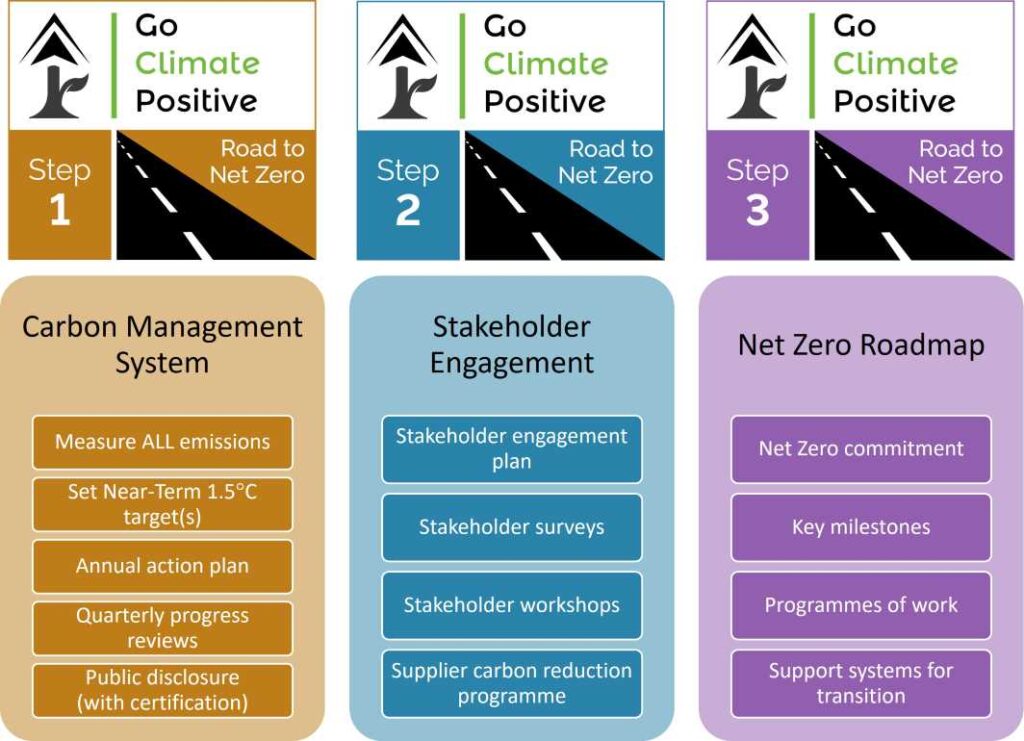
The Road to Net Zero
Our “Road to Net Zero” Programme will help you implement all the components of a meaningful net zero plan in a step-by-step manner – allowing you to build your net zero journey at the pace that is right for your organisation – in the knowledge that everything you do is aligned with the global net zero transition.
It will help you to:
• Make a long-term commitment to combating climate change and achieving “Net zero”.
• Prepare your business for the low-carbon economy.
• Demonstrate your credentials through certification.
Ready to Start your journey?
Before deciding on the best approach, it’s essential to clarify your goals. Whether you’re focused on understanding your carbon footprint, developing a robust reduction plan, or preparing for certification, defining your objectives will guide you towards the right solutions.
Contact us for a free consultation to explore how we can support your sustainability goals.
Written by Eoin McQuone
Eoin (pronounced like “Ian”) is the Chief Carbon Coach and founder of Go Climate Positive. He is a Practitioner member of IEMA (the Institute of Environmental Management) and a sustainability lead on the Cheltenham Economic Recovery Task Force.
Eoin says, “Sustainability is no longer a ‘nice to do’, it is business critical. My goal is to make it accessible and affordable for every business, however big or small , no matter their market sector.”

