
Realising bottom-line cost savings through carbon reduction
“Anything that causes you to use less energy, buy less stuff or create less waste will save you money as well as reduce your carbon footprint”.
Eoin McQuone
Founder and Chief Carbon Coach, Go Climate Positive.
Cost reduction and Carbon reduction go together
“Carbon reduction is all well and good, but we can’t afford it right now!” We hear this comment from smaller businesses all the time. It reflects a common assumption that carbon reduction is a purely altruistic act that costs money.
However, with a bit of planning, carbon reduction can also reduce your operational costs. There may be some upfront investment, but returns can be very worthwhile, with the potential to make your carbon reduction programme self-funding.
A well-designed carbon reduction programme can help you identify opportunities to both reduce carbon emissions and reduce your costs, leading to both reputational benefits and higher profits.
How does it work?
A well-designed carbon reduction programme, such as Go Climate Positive’s “Carbon Reduction Plan” will help you identify opportunities to both save carbon and reduce costs in a 3-step process:
- First, we make a comprehensive assessment of your carbon footprint, understanding the emissions generated by each of your business activities.
- Next, we help you identify activities in which reductions can be made and give you ideas for how to do that.
- Finally, we help you quantify the carbon saving and the return on investment of your reduction activities.
Anything that causes you to use less energy, buy less stuff or create less waste has the potential to do both.
Some Examples
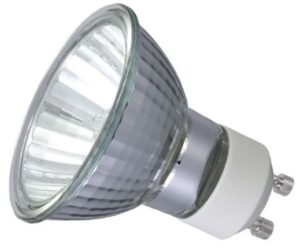
Use less energy by replacing halogen reflector lights with LEDs
Replacing traditional light fittings, such as halogen reflectors, with LEDs is a common way to reduce both energy consumption and the cost of purchasing electricity.
A typical halogen reflector lamp has a power rating of 50W. Let’s imagine a typical office which has 50 light fittings that are used 8 hours per day on weekdays. That’s an annual electricity consumption of 5200 kWh, which at a typical rate of 24p per unit, would cost around £1248 per year.
By contrast an equivalent LED lamp has a power rating of 4.2W. In the same office they would give an annual electricity consumption of 437 kWh, costing around £105. That’s an annual saving of £1143. It also equates to a carbon saving of 1.17 tonnes of CO2e per year (using the 2025 electricity fuel mix).
LED fittings do cost more to buy, however the difference in price has become much smaller in recent times. A recent survey (using the BLT Direct website) found that a typical LED lamp might cost £3.16 compared with £1.99 for a halogen reflector. When you also consider that an LED lamp has a lifespan of 15,000 hours compared with the 2000 hours lifespan of a halogen reflector we can see that, on average, each halogen lamp would need replacing once per year whereas the LEDs would only need replacing once every 7 years. This results in a further saving of £340 on the cost of replacement lamps over a 5-year period and a carbon saving of around 330 kg CO2e over the same period.
Results over a 5-year period | |
Total cost saving | £6213 |
Return on investment | 3932% |
Payback period (days) | 47 |
Total carbon saving (tCO2e) | 6.17 |
Buy less by cancelling unnecessary software licences
Most software systems operate over the cloud these days, are relatively low-cost and easy to sign up to. As a result, even very small businesses can find that they are subscribed to a surprisingly large number of these systems. Our own business of 5 people recently did a survey and discovered that we had paid subscriptions with 21 cloud-based software systems costing a total of £16,670.
On investigation 3 of these systems were found to be non-essential and could be unsubscribed. At an average cost of £13 per month per license this gave an annual saving of £2381 and ongoing carbon savings of 370 kg CO2e per year.
Results over a 5-year period | |
Total cost saving | £11907 |
Total carbon saving (tCO2e) | 1.8 |
Create less waste by switching from cardboard to reusable packaging
This real-life case study demonstrates the savings that can be made when businesses work together to reduce waste and improve efficiency through a supply-chain.
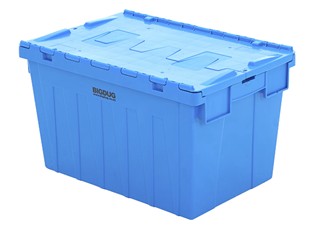
Securicor Omega Express (SOE), distribute books from the distribution centres of Macmillan Distribution Ltd, a specialist book wholesaler, on behalf of book retailer Waterstones. The books were traditionally packaged in one-trip cardboard cartons to protect them in transit. Working together the 3 business came up with a design for a durable, polypropylene box with an integral lid, folding walls and built-in handles that could be reused repeatedly.
A pilot scheme, involving 3000 of the new boxes, demonstrated the following benefits:
- Elimination of the need for 21,720 cardboard cartons, with annual savings of £7000 and 15 tonnes of waste.
- An estimated 95% reduction in paper packaging used as in-fill.
- Reduction in stock rejected on delivery through transit damage.
- Reduced cost of compliance with the packaging waste regulations.
When applied to all of Waterstones deliveries the new box delivered an estimated annual cost saving of approximately £1.5 million spread across the 3 businesses through reduced purchase and disposal costs of cardboard and removal of 3500 tonnes of waste.
We estimate the annual carbon savings to be approximately 3757 tonnes CO2e.
Results over a 5-year period (estimated) | |
Total cost saving | £7,500,000 |
Return on investment | 781% |
Payback period (months) | 8 |
Total carbon saving (tCO2e) | 18,578 |
We would like to thank Envirowise for this case study. Return on Investment and carbon savings are our own estimates.
Measuring return on investment
Measuring return on investment (ROI) doesn’t have to be complicated.
Start making savings
Many businesses are put off starting a carbon reduction programme as they are understandably concerned about the potential costs involved.
In practice, business that sign up to a carbon reduction programme, such as Go Climate Positive’s “Carbon Reduction Plan”, can recoup their investment several times over, by identifying and implementing projects that both save carbon and save money.
Get in touch today to talk about how this could work for your business.
Written by Eoin McQuone
Eoin (pronounced like “Ian”) is the Chief Carbon Coach and founder of Go Climate Positive. He is a Practitioner member of IEMA (the Institute of Environmental Management) and a member of the Carbon Accounting Alliance.
Eoin says, “Sustainability is no longer a ‘nice to do’, it is business critical. My goal is to make it accessible and affordable for every business, however big or small , no matter their market sector.”

